


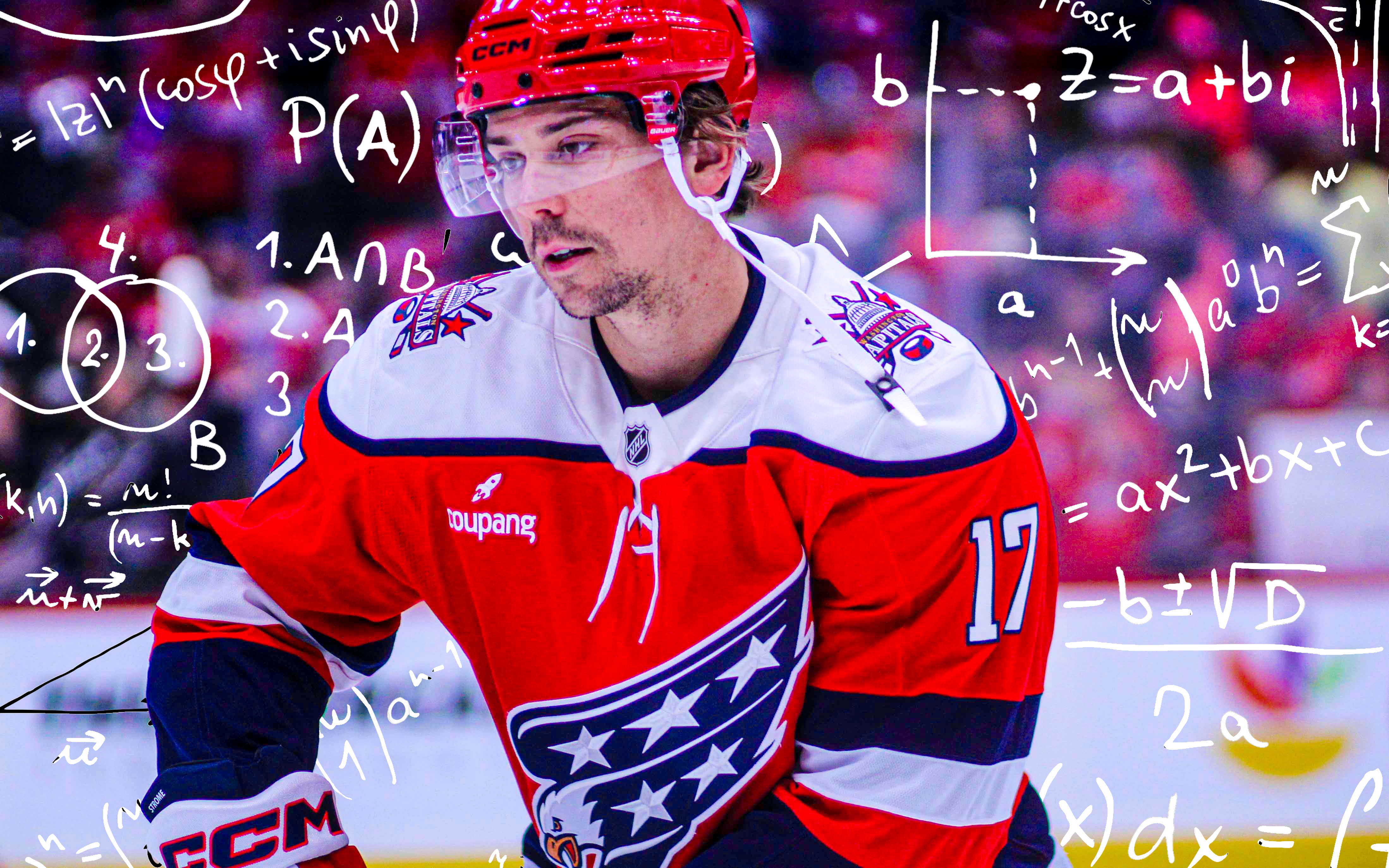
ARLINGTON, V.A. — As Washington Capitals coach Spencer Carbery says, “information is a weapon.” And Dylan Strome is always at the ready.
The 28-year-old has taken “student of the game” to an entire different level. Whether it’s upcoming milestones, advanced numbers or league leaders, Strome is able to answer any statistics-based question at the drop of a hat.
“This guy knows everything,” Carbery said. “He’s dialed in.”
Strome is cooling off after a long practice following two days off, but sitting in his stall at MedStar Capitals Iceplex, welcomes the challenge of being quizzed on different advanced statistics and what they mean around the NHL.
Without hesitation, he proudly recites definitions off-book of various stats thrown his way.
“Corsi for? It’s mainly based on chances when you’re around the puck, whether it’s you or your linemates, but it’s chances for when you’re on the ice relative to where you are on the ice.
“(Expected goals for), that one’s always confusing. I think someone has a grading system of what they thing should be a goal. There could be a wide-open net backdoor, but no one there. There could be two guys in your way. Expected goals is just what you someone — who’s doing it on the computer — expects a goal to be.
“(PDO) has something to do with — it’s combined shooting percentage and save percentage,” he noted. “Close to 100 is pretty good.”
He also correctly guessed the Capitals’ leading line at xGF percentage at 5-on-5, which also leads the NHL among combinations with at least 100 minutes played together.
“Sourdy, Tom and Pro,” he said; the Capitals’ second line of Aliaksei Protas, Justin Sourdif and Tom Wilson leads the league at 72 percent.
Strome has always been a fan of statistics and math. Growing up in school, it quickly became a favorite subject, and back in his junior days with the OHL’s Erie Otters, he and his teammates would constantly read the stat sheets and storylines.
“I was a math guy up until it got too hard,” Strome grinned. “Always multiplication and subtraction. Once long division and that other stuff came in — triangles? No. I was good at the quick math.”
Strome’s go-to sites are HockeyDB, and before games, he’ll pick up the NHL stats and media packets given to reporters covering the game. Following play, he’ll often have a copy of the game sheet with the event summary and game summary in his hand.
It goes beyond that, though; Strome is constantly trying to learn in any way possible, and will spend hours in the film room if the team lets him.
“He uses (stats and learning devices) to his advantage in the same way that we try to use stats and knowing different players and watching the game and knowing tendencies and face-offs,” Carbery said. “Dylan Strome always wants to watch all the guys he’s going up against on face-offs. Wants film of them, wants to see what they do, tendencies, what do they do in this situation. Anytime you’re equipping yourself with information — no different than a coach — you’re helping find any information you can."
“Information is a weapon when it comes to preparation, that’s what i would attribute to Dylan and how it would potentially help his individual game.”
Admittedly, for Strome, those advanced statistics and numbers are also helpful when the team is going through highs and lows, as it’ll be a clear indicator of performance and can help him pick up on different trends or where things need to change.
For instance, when the Capitals struggled out of the gate, Strome remained encouraged in trusting the process and used the advanced, underlying numbers, which pointed to positive habits for Washington, to avoid getting overly frustrated.
Eventually, the Capitals turned things around and now lead the East.
“We use it in a positive way… f you’re getting frustrated that you’re not winning games but your numbers are great, it’s like, well, who really cares? The Corsi for and stuff isn’t in the standings, but I think you can use it as underlying numbers, which our team talks about a lot and realizing that what we’re doing over the course of whoever has tracked this, they’re good numbers and you got to build on that,” Strome pointed out. “I think we did that, and the results eventually came.”
While Strome is a believer in stats, he noted that the good-old fashioned eye test remains a fundamental part of evaluating hockey. There’s always going to be positive or negative stats, but sometimes, numbers don’t really translate to what’s going on on the ice.
“Some guys are really tapped into all that. I think it helps in probably someway, pushes him in the right direction,” Nic Dowd said of Strome. “I think he just enjoys the game, I think he likes watching hockey.”
The one stat that Strome didn’t pick up on, though, was that he himself was among the Capitals’ top-three Corsi-for leaders at all strengths, and that he ranks second in Fenwick-for, which excludes shot blocks and can arguably be a better indicator of scoring chances.
The most important stat for No. 17, though?
“Wins,” he said, again, not skipping a beat.